
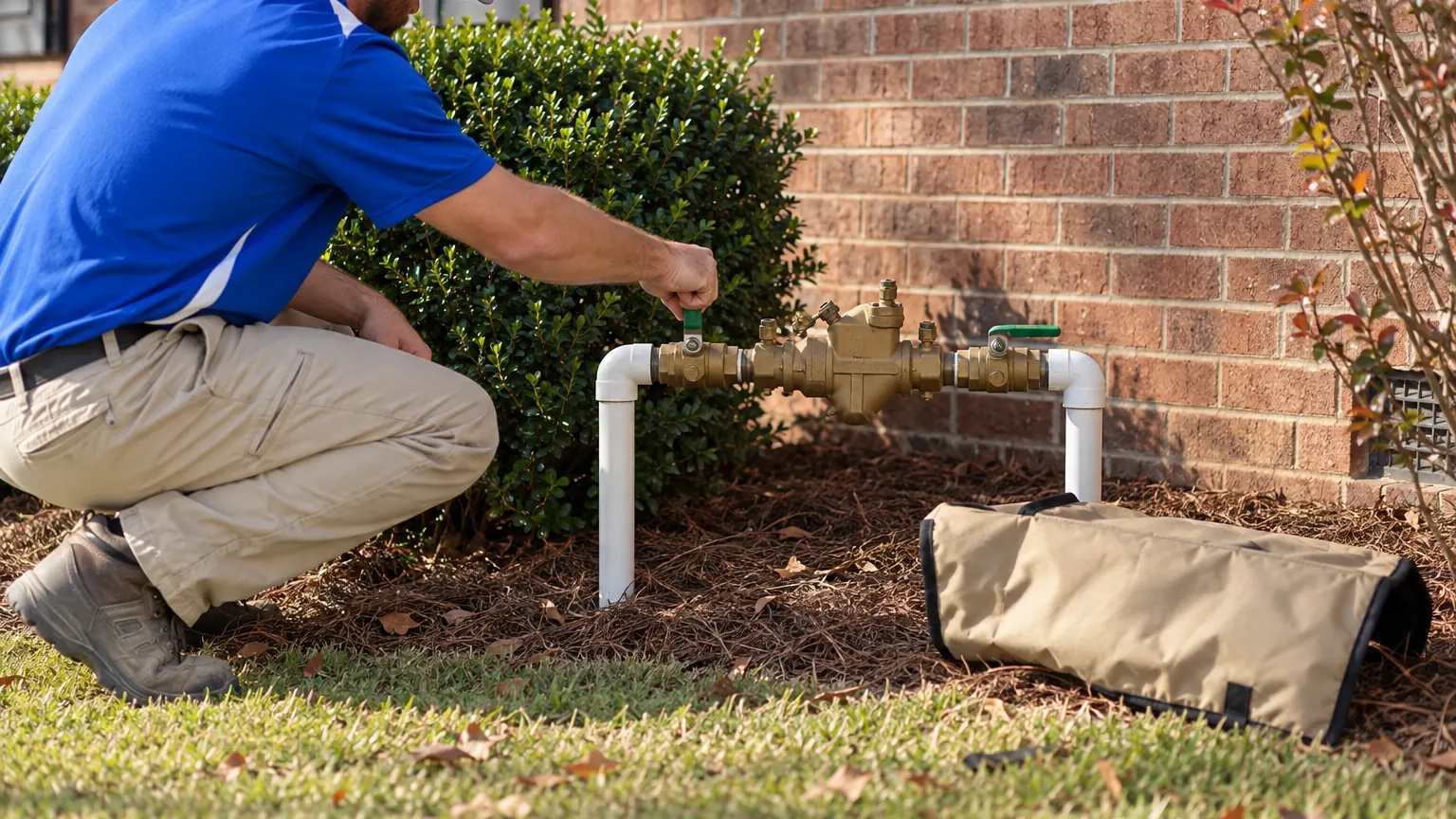
Do You Need to Winterize Your Sprinkler System in South Carolina?
Yes, in most cases, at least partly. Pee Dee winters are mild, and buried pipe is usually deep enough to be safe, but the backflow preventer, exposed pipe, and valves above ground can freeze on a hard-freeze night. Shutting off the water and draining those parts before the first forecast freeze is cheap insurance.
Does a sprinkler system in South Carolina really need winterizing?
It depends on what your system looks like, and that is why you hear both “you have to” and “nobody does that here.” Both are partly right.
In Northern states, pipes are buried deep and the whole system gets blown out with compressed air because the ground itself freezes solid. Here, the soil rarely freezes deep enough to hurt buried lines. The weak points are the parts that sit in open air or shallow in the ground:
- The backflow preventer, usually an above-ground assembly near the house or the meter
- The pipe running up to the backflow device and any exposed fittings
- Valve boxes that are shallow, cracked, or missing their lids
- Hose bibs or drip-line connections tied to the same supply
If any of those hold water when the temperature drops below freezing for several hours, they can crack. So the honest answer for the Pee Dee is: you probably do not need a full Northern-style blowout every year, but you do need a plan for the exposed parts, and you need to act before the cold night, not after.
How cold does it get in the Pee Dee before things are at risk?
Water freezes at 32 degrees, but a brief dip to 31 at dawn rarely does damage. Trouble starts when temperatures stay below freezing for several hours, and it gets much worse once you are in the mid to low 20s. A “hard freeze” is generally defined as 28 degrees or colder.
The first frost in the Florence area often arrives in early to mid November, sometimes earlier, and it varies a lot from year to year. Freezing nights are a normal part of every Pee Dee winter, and the temperatures well below freezing, including nights in the low 20s, are common enough that you should expect them. How many of those nights you get and how cold they get changes from one winter to the next, and those are the nights that crack brass and PVC above ground. You cannot predict how severe a given winter will be, which is why the cheap protection is worth doing every year.
Wind makes exposed parts colder faster, and a backflow preventer on the north or shaded side of a house loses heat quickly. Check the forecast from late October on, and watch the overnight low, not the daytime high.
What gets damaged when an irrigation system freezes?
The damage is usually small in size but annoying in cost, and you often do not see it until spring.
- Backflow preventer: The body or the internal parts can crack. You usually find out when you turn the system on and water sprays or leaks from the assembly.
- Exposed pipe and fittings: Split PVC or cracked couplings near the backflow device and any shallow runs.
- Valves: Diaphragms and solenoids can be damaged, causing zones that will not shut off or will not turn on.
- Sprinkler heads and risers: Water trapped in a shallow head can crack the body, especially on heads that sit shallow, stay exposed, or have water pooling around them.
The hidden cost is that a split pipe under pressure in March can waste a lot of water before you notice, and finding it means digging. That is usually the point where people call for irrigation repairs, and a good share of those calls trace back to a cold night the previous winter.
What does a sprinkler winterization involve, and what can a homeowner do themselves?
A typical winterization, whoever does it, goes like this:
- Turn the controller to off or rain mode so nothing runs on a schedule.
- Shut off the water supply to the irrigation system at the main shutoff.
- Relieve pressure and drain the backflow preventer and the pipe leading to it, following the manufacturer’s instructions for your model.
- Clear water from the lines. In the Pee Dee this can mean manual drain valves, or blowing the zones out with compressed air one at a time.
- Open any manual drain valves, check valve boxes, and leave things in a state where no water is trapped above ground.
A homeowner can do the simple parts: turn off the controller, close the supply, drain the backflow preventer, and insulate it. The compressed-air part is where people get into trouble. Air blowouts need a compressor that can deliver enough volume, not just enough pressure. Too much pressure can damage heads, valves, and fittings, and debris can fly out of a head under pressure, so eye protection matters. Never stand over or point at the backflow device while it is pressurized.
If your system has no manual drains or you are unsure of your pipe layout, it is worth having a pro do it. Our irrigation services include winterizations, along with startups and maintenance and repairs, so the same team that shuts a system down can open it again in spring.
What can you do short of a full blowout when a freeze is forecast?
If a cold night is coming and you have not winterized yet, protect the exposed parts. This takes about 20 minutes.
- Shut off the water to the irrigation system and open the drain or bleed valves on the backflow preventer so water is not sitting in it, following the manufacturer’s instructions for your model. Some assemblies hold water in internal chambers and need specific valve positions to drain fully.
- Wrap the backflow preventer and exposed pipe with insulation made for that purpose, then cover it with a waterproof bag or cover. A towel alone gets wet and freezes.
- Do not seal the wrap tight to the ground if water can still drip out; let drain openings stay clear.
- Make sure valve box lids are on and intact.
- Turn off the controller so it does not try to run a zone on a freezing morning.
Remove the wrap once the cold snap is over if you need the system to run, and close the drains again. Watering when it is below freezing is also a problem on its own, since ice can build up on pavement and plants.
A quick note on lawns: Bermuda and centipede go dormant in winter and need very little water. If you have overseeded or planted something new, it may still need a little water, so ask before shutting everything down for the whole season.
When should you schedule winterization, and what should you do in spring?
Aim for late October to early November, before the first forecast freeze, not after it. Waiting for the cold snap means you are competing with everyone else who noticed the same forecast. If you want a pro to do it, booking early in the fall is easier than scrambling the day before a freeze.
In spring, wait until the threat of hard freezes has passed, often late March to early April in this part of South Carolina. Then:
- Close any manual drain valves and make sure the backflow preventer handles are in the right position.
- Open the main supply slowly. A fast surge can cause water hammer and damage fittings.
- Run each zone manually and watch every head for leaks, low pressure, clogs, or heads that are tilted or broken.
- Look at the backflow preventer for leaks while the system is pressurized.
- Reset the controller with your seasonal schedule.
Some towns and water utilities have rules about backflow testing or inspection, and those vary. Check with your city, county, or water provider rather than assuming.
If you would like a second set of eyes on your system before the cold arrives, or help with the spring startup, you can reach out to us here and we will talk through what your setup needs.
Frequently asked questions
When is the first freeze in the Florence, SC area?
It often shows up in early to mid November, but it varies from year to year and can come sooner. Watch the overnight lows in the forecast from late October, and have your system protected before the first night near or below freezing.
Can I winterize my sprinklers myself?
You can handle the basics: turn off the controller, shut the water supply, drain the backflow preventer, and insulate exposed parts. Compressed-air blowouts are riskier because too much pressure can damage heads and valves, so many homeowners leave that step to a professional.
Should I shut off my irrigation system in winter?
Yes. Switch the controller to off or rain mode and close the water supply to the system. Dormant lawns need little water, but if you have new seed or plantings, check what they still need before shutting down completely.
Do I need to drain my backflow preventer?
Yes, it is the part most likely to freeze because it sits above ground. Shut off the supply first, then open its drain or bleed valves following the manufacturer’s instructions, and insulate it once it is drained.
What should I do to start up my irrigation system in spring?
Wait until hard freezes have passed, then close the drains and open the main supply slowly. Run each zone, check every head and the backflow preventer for leaks, and reset the controller schedule. If something does not look right, call for a repair before the growing season begins.
